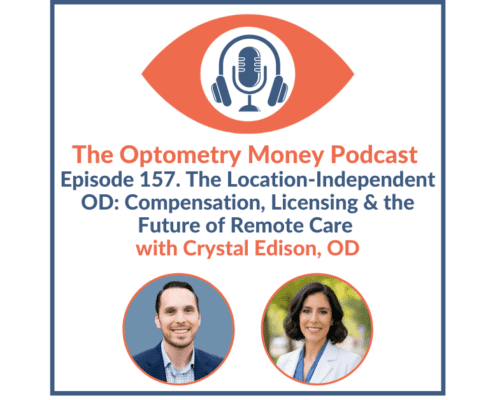
The Optometry Money Podcast Ep 157: The Location-Independent OD: Compensation, Licensing & the Future of Remote Care with Crystal Edison, OD
Remote optometry is growing fast – and there’s quite a range of opinions on what that means for optometry. In this episode, I sit down with Dr. Crystal Edison, a remote optometrist practicing across nine states from her home office, to break down the ins and outs of providing comprehensive remote care.
We cover contracts and compensation of remote ODs, how to navigate multi-state licensing, the technology involved, and Crystal addresses some of the most common myths about the quality and credibility of remote optometry.
Whether you’re a practice owner struggling to find associate coverage or an OD looking for more flexibility and independence, this one’s worth a listen.
What You’ll Learn
- What comprehensive remote optometry actually looks like and how it differs from screening-only models
- How remote ODs are compensated – W2 vs. 1099 roles and the financial trade-offs of each
- Key contract negotiation considerations including malpractice coverage and reimbursements
- How to navigate multi-state licensing without a national compact (and tools like ARBO’s CELMO that help)
- The technology investment needed on both the practice side and the remote OD side
- How practice owners can use remote staffing to fill empty chairs and reduce reliance on locums
- Common myths about remote care quality – and the clinical reality behind modern tele-optometry
Resources Mentioned
- Crystal Edison on LinkedIn
- Edison Remote Strategies — Crystal’s course, The Remote OD Blueprint
- Crystal’s Independent Strong article – Tele-optometry for Owners and Associates
- CELMO through ARBO — Council on Endorsement Licensure Mobility for Optometrists
- Podcast Ep. 2: Financial and Tax Planning for 1099 Optometrists
- Podcast Ep. 51: An Optometrist’s Guide to the QBI Deduction
- Podcast Ep. 66: Retirement Plan Options for Independent Contractor Optometrists
Want a more proactive approach to your planning?
You can schedule a no-commitment introductory call to discuss what’s on your mind financially and learn how we help optometrists navigate those same decisions nationwide.
The Optometry Money Podcast is dedicated to helping optometrists make better decisions around their money, careers, and practices. The show is hosted by Evon Mendrin, CFP®, CSLP®, owner of Optometry Wealth Advisors, a financial planning firm just for optometrists nationwide.
Subscribe to our podcast below!
Episode Transcript
The Optometry Money Podcast Ep. 157: The Location-Independent OD – Compensation, Licensing & the Future of Remote Care with Crystal Edison, OD
Evon: [00:00:00] Hey everybody. Welcome back to the Optometry Money podcast. We’re helping ODs all over the country make better and better decisions around their money, their careers, and their practices. I am your host, Evon Mendrin, Certified Financial Planner(TM) practitioner, and owner of Optometry Wealth Advisors, an independent financial planning firm just for optometrists nationwide.
And thank you so much for listening. Really appreciate your time and your attention today. And on today’s episode, I am joined by Dr. Crystal Edison. Crystal, and I dive into the ins and outs of providing comprehensive remote care in Optometry. And as I mentioned in the episode, there tends to be quite a wide range of opinions about remote Optometry, and it was great to get the perspective of someone providing remote care in a way she describes as directly on par with in-person patient care and someone that’s providing it day in and day out.
And she dives into her experience leading to [00:01:00] remote Optometry. The three main hurdles ODs need to face to practice remote Optometry well and addresses common myths about the quality and credibility of remote care. As a non OD It was so interesting and I am just fascinated to see where this can go, how remote care might be implemented in practices and the potential independence it can provide to Thomas is providing the care, and you can find links to all the resources we mentioned in the episode in the show notes, along with Crystal’s own course on how to get started in providing remote care. And without further ado, here is my conversation with Crystal Edison. Welcome back everybody to the Optometry Money Podcast. I am your host, Evon Mendrin, and I am excited to welcome onto the podcast Crystal Addison. Crystal, thank you so much for coming on.
Crystal: [00:02:00] I appreciate it. Thanks me.
Evon: Yeah, I am excited to talk with you. I’ve been following you online for a little while. I’m fascinated in your background. I’ve loved the content you’ve been creating, talking about your work in remote Optometry, and, this is an area where you don’t have to go very far to find quite a range of opinions about remote Optometry, remote patient care. And I’m excited to get the perspective of someone that works in remote Optometry, that’s someone that actually has the experience, does the work, and is now teaching others to take their careers in that same direction. And so I’m excited to learn from you today to talk with you, hear your perspective.
Crystal’s Optometry Origin
Evon: Before we dive into all of that fun stuff, I’d love to get just your background. What got you into Optometry? Where has your career gone from the beginning, up to this point? Tell us a little bit about your background.
Crystal: Sure. My path started back actually in high school, believe it or not. I took one of those career interest surveys and it pointed me straight towards healthcare. I ended up doing a research project on Optometry for [00:03:00] a finance class.
Evon: Ah.
Crystal: Was hooked, of all places. I love the balance that it offered, the rigorous clinical foundation, a wide range of practice settings, and the fact that I always enjoyed visiting my own eye doctor growing up too.
Evon: Ah.
Crystal: Yeah, so
Evon: That seems to be a common thread. When I have conversations with ODs, it’s usually two things. They enjoy the optometrist more than the dentist and that kind of pushed ’em in that direction. Or they just saw that Optometry had this excellent blend of healthcare field, medical field with balance. It didn’t seem to have a lot of the burnout side of other medical professions, and it seems to be a common thread. And from getting into Optometry then, where did your career go from there?
Crystal: So fast forward,
Buying a Practice and Burnout
Crystal: I started practicing in 2013, so now in mid thirties. I’m not sure if that makes me a seasoned veteran or just means I started before I could legally rent a car. But I’ve packed a lot into those years. I’ve worked the whole [00:04:00] spectrum of settings from corporate to private practice and even HMO settings.
Then I had a true full circle moment. Back in August of 2021, I had the opportunity to buy out the owner of the exact corporate practice where I had started as a new associate right outta school. The previous owner had been there for 25 years. On paper it had everything that I wanted. An established patient base, close knit staff, and promised store remodel on the horizon since it’s been open for a long time. And I thought being partnered with a corporate optical would ease the administrative burdens, but it really just shifted them. So our contract required us to be open seven days a week, and right off the bat, finding OD coverage was brutal. So I was working six to seven days a week by myself for quite a while. Plus I was getting squeezed from both sides once I finally found an OD to cover, trying to keep associates happy [00:05:00] with increasing pay scales and also dealing with diminishing insurance payouts due to inflation. It just was a huge issue for me.
Evon: It sounds like it just, it was not that perfect opportunity that maybe it appeared on paper.
Crystal: Exactly.
Evon: Yeah.
Crystal: Then two things happened that forced a change for me. So first was my son was born.
Evon: Ah.
Crystal: He’s two now. But my husband and I made a deliberate choice that professional success couldn’t come at the cost of not being present for a family. I was working a lot, as I had said before.
So second is that the promised story model just really never came. I realized that if I wanted to upgrade to things like auto phoropters and integrated testing to modernize the practice, not that it was unmodern, it just, I wanted to modernize it even more, was gonna have to come out of my pocket entirely. So I was at a crossroads. I either needed to sink more capital and time into a model that [00:06:00] was burning me out or choose to let it go. So I made the hard decision to sell. I was looking for just a better way to deliver care and discovered that tele Optometry could finally deliver genuine full scope eye exams. And I went all in. So I practice across nine states from like Washington to Florida in my home office, and I founded Edison Remote Strategies to help other ODs navigate that exact same transition.
Evon: Interesting. So you definitely have the experience in different modalities, different ways to practice and then due to just the investment you would have to make into a model you didn’t believe in, really a patient care model, a business model you didn’t believe in, as well as just you and your husband reflecting on family values and what’s more important, you decided to make a pivot.
Discovering Tele Optometry
Evon: And what was your first exposure to remote Optometry? How did you get into it in the first place? What exposed you to it in the first [00:07:00] place?
Crystal: That’s a great question, and here’s the honest version of the story because I think it’s actually more relatable than some polished origin myths for this. In 2023, a colleague of mine casually mentioned that she was doing comprehensive eye exams remotely, not screenings, not refraction only, full scope medical grade exams with a technician on site and her connecting via live video. And I remember thinking, wait, you can do that. That’s a real thing now. I’d been practicing, like I said, since 2013, over a decade at that point, and I had no idea that was possible. I was immediately drawn to it, so I started telling other colleagues and I got the same reaction every time. Wait, you could do that. Yeah. And these are experienced doctors, smart doctors, people who were plugged into the profession and they just had no clue either.
Evon:
Crystal: So that’s when I realized that this wasn’t just a career opportunity for me, it was an education gap that [00:08:00] our entire profession had. Technology had matured, the demand was exploding, and ODs just simply didn’t know it existed. The data backs it up. So I actually surveyed almost 200 ODs through Optometry
Why is Remote Care Optometry Growing?
Crystal: related Facebook groups recently, actually the end of 2025 and over 60% said that their primary motivation was either flexible side income or full career change. And here’s the kicker for your audience. The biggest barrier wasn’t clinical skepticism. It was legal anxiety.
Evon:
Crystal: 40% said liability and licensing concerns were their number one obstacle. They want to do this. They’re just terrified of doing it wrong.
Meanwhile, you have practice owners who physically cannot find Associate ODs, including me at a time. The AOA’s 2022 Workforce study confirmed the staffing crisis. Exam lanes are sitting empty. Optical revenue is tanking. [00:09:00] Remote care solves both sides of the equation. It fills empty chairs for owners and gives associates the flexibility and sovereignty they’re craving. And that’s what made me go all in.
Evon: That’s an interesting point. I know just with my own clients, particularly those that are in own, their own private practices in more, smaller towns, underserved areas, very profitable, productive practices, doing great work for patients are just having trouble finding associate doctors. Not only as just a, to meet demand of patient care, but also just in terms of succession of the business itself. And I definitely see it from the perspective of clients, of just the struggle to bring associate doctors into those areas where it’s underserved already. And it sounds like you’re seeing remote Optometry as a way to fill some of these gaps, by allowing ODs, you, I’ve heard you say it, it’s the location independent OD. It’s allowing those ODs to work where they are, but still provide what you’re seeing is still high [00:10:00] quality patient care to those patients.
How Are Remote Optometrists Compensated – W2 Employed Associates vs. Independent Contractors
Evon: And you talk about just in some of your writing, you talk about three big hurdles that you had to overcome on your own going through this yourselves and now you’re trying to help other optometrists. Hop over, and that’s the money side of it. It’s the legal side of it, and that’s the technology. So walk through some of those hurdles. Let’s start with, I guess the financial side of it and the structuring of compensation and contracts. What do ODs need to think about from that perspective?
Crystal: Alright. Yes. This is gonna be a fun one because it’s right near wheelhouse.
Evon: Yeah.
Crystal: Let me share what I’ve seen in the trenches and you can tell me where tax codes and things back it up.
Evon: Uh-huh
Crystal: So the first thing that ODs need to understand is that going remote doesn’t necessarily mean taking a pay cut. Now, there are some stats floating around, specifically though $178,000 for remote ODs for average pay versus [00:11:00] $142,000 for traditional roles. I wanna be upfront with your audience that those figures actually come from the 2025 Jobson income study, comparing independent practice owners to employed ODs. So not remote specifically versus in-person. Most remote only ODs according to that study earn around the range of $145,000 to $160,000 for full-time for a year, which can push higher if you are maximizing hours across multiple state licenses.
But here’s why the core message still holds. When you factor in what I call the zero overhead advantage, so no, when you’re an associate OD working remotely, you have no commute costs, no office rent, no retail management. Your effective take home pay often exceeds what the $142,000 W2 salary actually delivers. So remote platforms also allow ODs to see four or more patients per hour compared and easily compared [00:12:00] to the traditional two to three, which means higher production based bonuses.
And if you’re living in lower cost of living areas while working for practices in higher reimbursement states like Washington or New Hampshire, your dollar stretches even further. So you’re selling your clinical decision making, not subsidizing retail operation.
Now, the big question every OD asks is, should I be W2 or 1099? Because there’s both options available for remote care. And the honest answer is, and I’m sure you have this conversation with all of your clients, most of your clients too, is it depends on where you are in your career. If you are, I tell, if you’re early career with heavy student loans and you’re risk averse, a W2 role gives you that stability, employer-covered health insurance, retirement contributions, malpractice coverage. That package is worth roughly 22% on top of your base [00:13:00] salary, and that’s real money for those benefits.
The doctor who wants to build wealth, and Evon, I know this is what your clients ask about, the 1099 independent contractor model opens up an entire tax code. Here’s the framework I teach. You form an LLC. You can elect S corp status and suddenly the game changes. Pay yourself a reasonable salary and remaining profit comes as distributions that aren’t subject to that 15.3% self-employment tax. So if you’re a practice owner on $220,000 for net income, that strategy alone can save over $12,000 a year.
Then you stack the QBI deduction on top of that. The section 199A, have the notes here for that. I wouldn’t remember that otherwise, but that, so eligible contractors can deduct the 20% for the qualified business income. And as a [00:14:00] 1099 your home office, high speed internet, multi-monitor setup, and your license renewals, all of that becomes deductible. And here’s the piece that I think gets undersold is retirement acceleration. A traditional W2 caps your 401k contributions at about $23,500 a year. With a solo 401k as an independent contractor, from what I found is you can put away up to $70,000 a year, or $77,500 if you’re over 50. So that retirement strategy, that’s what the W2 simply can’t match.
Evon: I’ve got a couple questions. So you, in your experience, it sounds like you’re seeing that there is both the opportunity to, there’s enough roles to be able to select between actual W2 employed remote associate positions versus creating more of an independent contractor arrangement with other practices. Is that [00:15:00] correct? You’re seeing enough roles in both directions.
Crystal: Yes. Especially with certain companies, like I’ve seen a lot of W-2s, especially the full time, you’re looking for full-time W-2s with companies like My Eye Doctor has a lot of those roles available.
Evon: Most of the larger platforms like Digital Optometrics and 2020 Now,
Crystal: have a mix of both, depending on if you wanna go full-time and depending on multi-state licensing. If you’re available, depending on which states that you’re available in, the days that you’re available in, they may offer you W2 versus the 1099.
Evon: In terms of 1099 roles, this question of should I be W2 or 1099? The podcast episodes and the articles I’ve written on this continue to be one of the top searched. This question just keeps coming up. One of the first things to figure out is, is it actually a W2 role or is it actually an independent contractor role? ‘Cause there’s a legal hurdle, like it either is or it isn’t. We really don’t have the ability to flip a switch. A lot of [00:16:00] these 1099 roles that you hear asked about, they’re really W2 roles where they’re just called 1099 so that the employer can save on some employment taxes. So that’s kinda the first hurdle, is that they need to figure out, okay, is this really a W2 role or is it not?
If it is, you’d wanna make sure you’re getting the benefits and protections that come with that role. But it sounds like from the 1099 perspective, like there is the opportunity to build really independence to allow you to have control of your schedule. What is that experience like from the role of the independent contractor? What does that independence look like? The freedom that comes with that?
Crystal: So one thing that I love about the 1099 model is contract stacking. So you’re not tied to one employer.
Evon:
Crystal: I teach my students to think about time zone arbitrage. You can work a morning shift for an east coast practice or platform that has a lot of East Coast [00:17:00] states or offices available, and an afternoon shift in a west coast practice and pick up premium weekend shifts if you’re okay with working weekends, that pay anywhere from $600 to $1,000 a day, depending on bonus incentives. That income diversification is something no single W2 job can give you.
But that being said, the W2 job does come with its benefits as well. So that’s why it’s, there’s no right answer.
Evon: Yeah.
Crystal: It depends on what you wanna do, what type of flexibility you want.
Evon: And what you said earlier, I think definitely makes sense. There is a part of that’s based on risk tolerance of the OD and there are trade offs. Yes, independent contractor. There’s the non-financial aspects where you’re able to build more independence into your life, potentially have more freedom and flexibility over the schedule.
There’s the financial side of that, like you mentioned. There’s the ability to benefit from reasonable business deductions for any deductions you’re taking or any expenses that you have to pay as a part of your work. There’s the 20% QBI deduction, which is a business deduction as [00:18:00] well, that you benefit from. You don’t get to benefit from that as an employee. There’s the ability to open things like solo 401Ks, which are a substantial lever for investing and tax planning. There’s the ability to elect S corporation status, like you mentioned. Now, that doesn’t make sense for everybody. I’ll just caution to the listeners. Anytime you hear about this in a lot of the online groups, almost everyone recommends you do this, but it doesn’t always make sense. There’s a threshold of income that you really need to make in order for that to make sense from a tax and a cost standpoint. And there’s some state nuances too, where it just doesn’t make sense in certain states.
Outside of those nuances, that’s an option. That’s a lever. You can choose to pull that you don’t have as an employee, which is phenomenal. So you get all these business planning aspects that you wouldn’t be able to get if you were an employee. Now, the other side of that is what you mentioned, you lose out on some of those benefits, right?
The employee match. Any insurance benefits, you have to think about malpractice for yourself. Malpractice insurance is a part of [00:19:00] that. Potentially you are missing out on contributing to state and local government benefits such as paid family leave, such as disability insurance. So those, some of those things you need to basically recreate on your own.
Tax payments you have to navigate on your own. Before, if you’re an employed OD your employer is handling those tax payments outta your paycheck, you have to manage those on your own now. And with the addition potentially of self-employment taxes. So there’s some pros and cons, but that freedom and flexibility is a big non-financial benefit that you don’t get to benefit from if you’re an employee. You’re stuck with the schedule, right? That’s basically what it is. That’s a big benefit that doesn’t necessarily have a dollar sign attached to it, but you gotta see how valuable that is to you.
What Should Remote ODs Consider When Negotiating Compensation and Contracts?
Evon: And in terms of like how you are negotiating or talking through these contracts with different potential, not necessarily employers if you’re 1099, but how are you thinking [00:20:00] about discussing compensation? If you’re a 1099 contractor, how are you thinking about negotiating these different contracts? What are some basic things we should be thinking about?
Crystal: Great question. So when you’re thinking about different contracts and what the employers are offering, even with 1099 there’s a lot of employers that will cover malpractice, but you gotta be careful with the type. Make sure to review it and make sure that it is claims based versus occurrence based. You want to, if they would cover the tail coverage at the end, because it could be very, a hundred up to 150 to 200% of the annual premium. So that could be very expensive if it’s not covered at the end versus occurrence based, which is a little bit more expensive for the employer. But then that covers even after, if a, even after an employee leaves or a contractor leaves.
I always recommend asking for the coverage, but if it’s [00:21:00] claims based, it might still be worth it to have your own coverage. Malpractice with either AOA or Lockton Affinity is pretty good. One that’s, I actually use, it’s, and for me it’s less than $500 a year, which I don’t think is too bad. And
Evon: Not too bad. Yeah.
Crystal: just to cover the bases. And if I’m working for multiple companies, it’s better to have that extra coverage and it’s not too much, depending on the occurrence versus over the aggregate, like how much you’re asking, you’re paying for.
Evon: Yeah.
Crystal: That’s what I recommend looking at. And asking for higher pay if you’re a 1099 is something I recommend as well because they’re, the employer isn’t gonna be paying for that employer taxes, so why not pay a little bit more to make up for it? In those cases, asking for reimbursements for licenses and just having all of this in writing because if you just have it verbally said, it may not necessarily come to fruition. It’s really important to get everything in writing. [00:22:00]
Evon: Gotcha. That makes sense. And it is good to know that you are often able to get the malpractice insurance, at least some form of malpractice insurance covered even through those 1099 contracts. And so there’s the financial side, benefits and drawbacks to either W2 associate side or 1099 direction.
How to Handle Multi-State Licensing as a Remote Optometrist
Evon: Now let’s talk about the licensing or legal aspects of that. Now, this is something I know very little about, so I’m interested to hear your perspective here. What do ODs need to know to navigate this multi-state licensing maze for being a location independent OD?
Crystal: All right, so this is a hurdle that scares most ODs.
Evon: Yeah.
Crystal: I know because it scared me too, just getting into it. And I want to start by addressing, unfortunately, there is no interstate Optometry compact. So ODs that have nursing friends or PA friends that are bragging about their compact license that works in 30 plus states, we don’t have that unfortunately. So the AOA back in 2023 actually studied [00:23:00] this and recommended against pursuing a compact because scope of practice varies so wildly from state to state for Optometry. For example, a doctor in Oklahoma can perform laser procedures that a doctor in Massachusetts can’t. So you can’t unify those under one license.
So the reality is if you want to practice in five states, you’ll hold five separate state licenses, pay five separate fees and answer to five separate boards.
Now, before everyone turns this off in despair, it’s very manageable once you have a system. It’s what I’ve learned maintaining nine state licenses.
First, most states use what’s called the endorsement or reciprocity, so this is based on substantial equivalence. So translation is if you are already licensed in a state with equivalent or higher standards, many states will fast track your application without making you retake board exams. Washington State, for [00:24:00] example, which is my home state, recognizes licenses from 29 other states as substantially equivalent. So you don’t have to start from scratch every time.
Second, there’s a tool called CELMO or CELMO, I’m not sure exactly how they say this acronym, but it’s the Council on Endorsement Licensure Mobility for Optometrists. Think of it as a common app for Optometry licensing. You submit your transcripts, board scores, and license history onto abo.org. So this is who created it. They verify everything, and then when you apply to a new state, instead of requesting records from every school and board yourself, you just hand them your CELMO certificate. It doesn’t replace state applications, but it cuts the paperwork burden dramatically. It currently is recognized by 11 states and it’s growing constantly. So [00:25:00] I’m hoping that it’ll cover most of the states pretty soon, but that’s a pretty good chunk right there with the 11 states.
Evon: Yeah.
Crystal: Third is, this is strategic. Not all state licenses are created equal. States are what I call gold mine states. So high demand for remote ODs, fair reimbursement, and straightforward telehealth regulations. Others are regulatory swamps. Knowing which to target is critical first. I teach a framework I call the multi-state sniper strategy. Instead of trying to get licensed everywhere, you wanna target the five to seven states that will give you maximum scheduling flexibility and earning potential.
Evon:
Crystal: And from a financial perspective, every state license fee, renewal fee and CE expense is a hundred percent deductible if you’re a 1099 contractor.
Evon:
Crystal: States like, and like I said, most employers will cover these reimbursement fees. This is something that you want to negotiate when you get hired on.
States like Washington run about $160 annually, so not much. But [00:26:00] other ones are more expensive, $500 range. Could be more depending on how much CE you need to get, or if you need to take board exams through that state, like North Carolina, you need to, they only run it once or twice a year, and you have to fly into North Carolina to have that done. But that’s a huge one right now.
Evon: It adds up, but it’s a business expense that directly expands your earning capacity. So you’ve, I’ve seen you describe your licenses as like your inventory, and it sounds like you can be choosy with your inventory. You don’t necessarily need to have licenses everywhere. You just need to have licenses where it’s most impactful. At least for your work as a remote OD. And it doesn’t sound fun to have to deal with each state separately. But I guess that’s part of the work that you have to do, although it sounds like there are some tools like ARBO’s tool there to compile some parts of that and make it a little bit easier to manage all that. And the licensing part of that is the second hurdle. [00:27:00] And while it does sound daunting, there are some tools to make that simpler and it sounds like it’s improving.
What Technology Investments Are Needed to Support Remote Optometry for Both Practice Owners and Remote ODs?
Evon: And then the third hurdle you’ve mentioned is the technology. And what kind of investment do we need to see here? Either on the employer side or the actual practice side or for the independent OD.
Crystal: So it, yeah, it just depends. If you’re a practice owner, it could be pretty hefty because you’re needing to make sure you have the automated phoropters. I always recommend ultra widefield cameras. Not everybody has that, but like the Maestro has a combined unit with the OCT, which I love as well and has amazing photo quality. So it depends on which direction you wanna go and what type of technology you wanna incorporate. I do have a remote eyecare return on investment calculator where ODs can plug in the numbers, just depending on the representatives that they’re working with, and can really find out based on how much money they’re getting for like per patient on average, [00:28:00] if it makes sense for them to go remote, either with a platform or direct hires. That’s another big thing. But really for the associate on the other side, it’s pretty reasonable because you really need either a really good laptop or desktop, home office, so desk, chair, multi screens, at least dual monitors is really important. I like my triple monitor setup. And really that’s it. So it could be around $2,000 to $3,000 is the range for the associate remote OD and could find employers that may pay for that or send you the hardware.
Evon:
Crystal: In most cases you’re, especially 1099, gonna have you pay for that. And that of course you would take as a business expense versus them paying for it as a reimbursement. So it varies widely on how much because if you’re a [00:29:00] practice owner, you could spend a lot. But it’s either, for me, in my situation, if I were to keep my practice and invest the money to upgrade all the equipment so I could have remote eyecare at my practice, it’s either do I, if I were to lose an associate OD again, it’s having the empty chair time or me having to be there instead of being there for my child. It’s there’s really that give and take. But to go back to the financial side here, it can be quite a bit. So for platforms, it can cost a bit more upfront versus direct hires, but in the end, direct hires can actually cost more versus the platform.
Evon: Can you describe what platform means?
Crystal: Sorry. Yes. Let
Evon: Yeah, that’s, yeah.
Crystal: That is a great question. So platforms, I’m talking about the, like Digital Optometrics and 2020 Now that are the large software companies that make it possible to, they have their own systems with the video conferencing and their own, they [00:30:00] teach the technicians, they have their own system and they usually contract out to other private practices or other practices like My Eye Doctor, Visionworks, Costcos, things like that. Then you have the brands like My Eye Doctor, Visionworks, that may hire doctors directly as W-2s versus contracting out to the larger platforms. So it’s interesting that there can be offices that have both. Some days where they have platforms with platform doctors logging in versus other days where they have their own employed ODs logging in. Then so it’s really a hybrid model because then you could also have your own onsite ODs that can focus on the medical eyecare because you have the remote doctors doing most of the comprehensive exams and referring those patients in for dry eye management or glaucoma management, what have you. So [00:31:00] that’s what’s nice about it, is it creates your own referral system without you as a practice owner needing to be there.
Evon: So on the practice side, there’s an investment to basically build the infrastructure to make this possible. It’s equipment, it’s internet, video, and then on the OD side, that’s the provider side. It’s mostly just computer infrastructure, right? So you can get online. It’s high speed internet. You have enough monitors, you’ve got the computer to be able to actually carry out the care.
And that’s interesting from the perspective of the private practice. You hear a lot about using technology, things like AI scribes and different things like that. But this seems like an interesting use case to be able to, especially in underserved areas where you’re gonna, you could have this remote OD providing primary patient care and then having in-person ODs focusing more on medical care, things like that. That’s an interesting use case of this blended hybrid model and we have a platform opportunity where you can tie into these platforms. [00:32:00]
And it sounds like these platforms are providing the ODs, is that correct? Like they’re the ones finding ODs to provide the care.
Crystal: Yes, that’s a, so it depends on what the practice owner wants to do. Practice owners can hire them on and pay per exam or a monthly fee just depending on which platform they end up going with.
Evon: Okay.
Crystal: The big ones right now are Digital Optometrics and 2020 Now.
Evon: Yeah.
Crystal: So they, or they can choose to use their system and hire their own doctors as well, as another option. Some practice owners may prefer to have that more control over who, which ODs log on, where they don’t have that control as much when you have, when you’re hiring a platform and it’s available that day, that logs in and picks up the patient. Having your own direct hire that is set for that specific day, for that schedule, and who’s actually seeing those patients. In those cases too, what I talk about [00:33:00] in my course is, you can discuss different triage options. So either the higher end triage option where your remote optometrist can actually do some more medical care versus with platform doctors, they’re may more geared towards comprehensive routine care and referring for some more of the medical care, like dry eye or glaucoma management, things like that. Which is, I think, a great option as well, because then again, you save the medical care for the onsite doctors, whether it’s the practice owner or one of the other onsite associates that you have working a couple days a week here and there as well.
Evon: And then from the provider side, the OD side, they can, it sounds like to find those opportunities, they can either go to the platforms themselves or look for direct employment opportunities with some of these practices. And
Crystal: Exactly.
What is the Quality of Patient Care in Remote Optometry?
Evon: So I’m curious, I’d like to ask you. You don’t have to look very hard in a lot of these [00:34:00] online Optometry groups to see a pretty, let’s just say a pretty wide range of opinions about the quality, credibility of remote Optometry. Some very strong in all directions. And I wanna get your perspective on that, in it, in remote care every single day. And first, can you just describe like what does the patient experience look like when they get remote care? What does that look like from the patient’s perspective when they enter the practice and they’re going through that, what does that look like?
Crystal: I’m glad you asked that question because I think there’s a lot of outdated skepticism floating around, like you’ve said. And I get it. When ODs first hear telehealth eye exams, most of us picture some direct to consumer app cranking out prescription renewals without ever looking at the retina.
That model does exist, and it’s, I think that’s dying down. And I understand the concern about it, but that’s not what we’re talking about. So let me bust those [00:35:00] myths right here. So myth number one is remote exams are just refraction mills. The fact is the clinical standard I teach and what’s available in most models nowadays, the major platforms, is comprehensive medical care. We’re evaluating OCT scans, in most cases ultra wide field retinal images, intraocular pressures, visual fields. The diagnostic data available in a well-equipped remote lane is actually in a lot of the cases superior to what many traditional practices have, because, or at least on par because the technology investment required to for remote work pushes clinics toward that better equipment. So I always tell skeptics, if you’re making a clinical decision based on an undilated view or a dilated view through an old BIO and 78 lens, I’m making mine from a 200 degree ultra wide field image, and in many cases high resolution OCT scans.
So tell me which one has better [00:36:00] documentation. I think it’s so important to get that BIO view and I refer patients for DFE when necessary. But those 200 degree views, even in practice like onsite, I relied on my Optomap quite a bit. So for a lot of things.
So myth number two is patients could tell it’s not a real experience and experience suffers. So fact is patient satisfaction in hybrid tele Optometry visits have been consistently high in published literature. The key is webside manner. You have to be intentional about building rapport through the camera. I teach a technique that is called like the narrated exam, where you talk to the patient through every step, so they never feel like they’re just staring at a screen waiting for something to happen. You’re actually more communicative in a remote exam than many doctors are in person because you have to be. And myth number three is it’s a race to the bottom on the pay and quality. [00:37:00]
So fact is, as we just discussed, remote work is not a pay cut in many cases when you account for zero overhead, geographic pay arbitrage, and higher patient throughput on remote platforms. The effective compensation for tele ODs is competitive with and can exceed traditional employed roles. The demand is only growing.
The tele Optometry sector is expanding at a compound annual growth rate of about 12%. So this isn’t going away. When there’s a staffing crisis and technology works, the doctors who adapt early have the leverage and the practices that invest in quality remote exam systems see better patient retention and higher optical capture rates because they’re no longer leaving chairs empty. Yeah.
Evon: It sounds as you kinda go through these myths, I like the webside manner,
Crystal: Yeah.
Evon: and I’ve certainly seen that as, for myself as a financial planner working remotely. Obviously [00:38:00] financial advice and Optometry are not the same thing. But I’ve definitely seen that it is something different to build relationships with people through a screen.
And you can get the sense sometimes, like there’s something missing if you’re not in person. It is a different skillset and it just takes practice and time to get comfortable talking to people virtually, building that relationship virtually and building confidence in the service and care you’re providing.
And again, I know financial advice is much different than Optometry, but that webside manner, I love that term, is a skill that can and needs to be learned. It is different than working with someone in person.
And a lot of times we, I think when we feel that there’s that difference, that friction, a lot of the times I felt that it’s because I just need to improve my own webside manner. I just need to improve my own skillset and ability to communicate virtually. And it sounds like [00:39:00] you’ve seen that as well. And it sounds like from going back to myth number one, it sounds like there are the same quality and types of tools and diagnostic tools available. It sounds like there’s a skilled technician involved. It sounds like there’s still a skilled optometrist involved. This isn’t those 1-800-contact-lens apps that are just doing this self-service. It sounds like in your experience at least, you’re still seeing the same high quality care that you would’ve seen provided in-person visits. Is that correct?
Crystal: Exactly. I think remote Optometry is actually going to strengthen independent practice, not weaken it. Because you can have the same level of care and the research backs it up. Think about the rural practice owner who can’t hire an associate. Their only options right now are to reduce hours or sell to private equity in a lot of cases. So remote staffing gives them a third option. Keep the doors open, keep the patients, keep the independence.
Evon: I think that’s a fascinating use case. If there are any listeners [00:40:00] that are doing that sort of hybrid, the hybrid work in your practice, I’d love to hear from you. So reach out. I think that’s a fascinating use case, especially again for those, we’ll call ’em small town settings where it’s already underserved and practice owners are just struggling to find associate doctors. And I would be fascinating to hear if anyone’s implemented that. And just seeing the response from patients, how that care has been, I’d love to hear from you.
But I think that’s such a fascinating use case. And as we wrap up, Crystal, I think this has been great. Are there any thoughts that you’d love to leave with the listeners on either preparing or carrying out, just the quality of remote care? Any final thoughts you’d wanna leave the listeners?
Crystal: Yeah. Thank you. Evon, I wanna just add something important here because I don’t want anyone to think I’m saying that the only valid model is what I do. While remote hybrid tele Optometry with a trained technician is the gold standard for comprehensive care, and [00:41:00] that’s what I teach as the primary pathway, there are screening level models that are becoming more mainstream and they’re not going away. And I believe that they serve a real purpose. So thinking again about the rural and underserved communities where there is no optometrist within an hour’s drive, for those patients, a remote screening that can provide a glasses prescription is a massive improvement over no access at all, and can provide some screening to get them referred for further patient care in a lot of cases.
So these models are expanding. Think of companies like iBot with their kiosks. There’s genuinely needed to improve patient access in areas that our profession has struggled to serve. So I might be a little bit, there might be some controversy here, but I’m not saying that’s, I’m trashing that at all. I think it’s a great option. But they’ve even said they’re not comprehensive care and it’s to integrate and make sure that patients get the care that they need, [00:42:00] get the glasses that they need. So I’m not telling ODs to completely avoid those. Yes, I think the hybrid model is the gold standard.
What I’m saying is understand the limitations. A screening exam such as from a kiosk is not a comprehensive exam. If you are providing a quick glasses prescription remotely, make sure you’re documenting that scope clearly. Make sure the patient understands what they’re getting and what they’re not getting. And always choose patient safety over throughput. That’s the line that separates responsible remote care from the stuff that gives our profession heartburn.
Evon: Yeah, I love that. As a patient, I love to hear that. Thank you for saying that. And when you think about the future of Optometry and perhaps from your perspective, remote Optometry, what most excites you?
Crystal: Oh man. That there’s gonna be more opportunities and there more of the ODs graduating now are gonna know about this. [00:43:00] About telehealth and gonna be trained on it coming right out outta school. And that there’s gonna be more care available. And that there’s more flexibility to live basically wherever you want in a lot of cases, which is really nice too. I think that’s gonna be helpful for a lot of ODs out there.
Evon: Yeah. Yeah. I appreciate your time, Crystal. I appreciate your perspective here. Again, I’m looking at this not being an OD. I’m looking at this from the outside looking in. But I’m fascinated to see how this all unfolds, as Optometry moves forward here, both in terms of how my private practice clients implement, or whether they do choose to implement some of these tools and methods and models, or how my non-practice owner clients, the opportunity for them to build more freedom and independence into their life. I’m just fascinated to see where it all goes and how I see it unfold throughout Optometry. So I appreciate your time. It was great to get your perspective and hear all of your thoughts on these things. Where can listeners [00:44:00] find and follow and learn more about what you’re doing?
Crystal: Thank you. So I am pretty active on LinkedIn, Crystal Edison OD, that’s first and last name. And my website is edisonremotestrategies.com. The E-D-I-S-O-N for the first part. And yeah, I have my course available on there.
Evon: What is your course?
Crystal: Oh yes. So my course is called The Remote OD Blueprint, and it’s an eight module training system that walks you through everything we talked about today. So the money, the law, the technology. It also covers contract negotiation a little bit more, clinical protocols for remote charting, how to build your resume for remote work, and how to survive your first 30 days in a new remote position. So it’s designed for a colleague to colleague, like mentoring experience. No fluff. No filler. You can find everything on that website. And that’s pretty much it. Perfect. That’s great. Now I
Evon: will put links to all these different things in the show notes, so listeners can find all these different things to [00:45:00] find your course, learn more about you. And we’ll link to your LinkedIn profile as well.
For listeners, again, really appreciate your time and listening today. We will catch you all on the next episode. In the meantime, take care.
RECENT POSTS
- The Optometry Money Podcast Ep 157: The Location-Independent OD: Compensation, Licensing & the Future of Remote Care with Crystal Edison, OD
- The Optometry Money Podcast Ep 156: Listener Q&A #2 – S Corp Salary, How Much Practice Cash to Keep, Buying Practice Real Estate, and More
- The Optometry Money Podcast Ep 155: Are Your Retirement Accounts Protected from Lawsuits? A Guide for Optometrists
- The Optometry Money Podcast Ep 154: Trump Accounts for Kids – What Optometrists Need to Know
- The Optometry Money Podcast Ep 153: How to Invest Tax-Efficiently and Keep More of Your Returns (After-tax)
 Optometry Wealth Advisors LLC
 Optometry Wealth Advisors LLC
 Optometry Wealth Advisors LLC
 Optometry Wealth Advisors LLC